Artificial Intelligence for astrophysics: Inria Chile and Universidad Diego Portales identify the structural limits of 3D stellar atmosphere modeling using physics-informed neural networks
Date :

In 2022, Inria Chile and Universidad Diego Portales (UDP) signed a Strategic Collaboration Agreement, marking the beginning of an ambitious scientific journey at the frontier of artificial intelligence and astrophysics. This partnership has enabled the Center to work closely with UDP’s Faculty of Engineering and Sciences and its Astrophysics PhD Program to tackle one of the central challenges of modern astronomy: the intensive use of data and computational models.
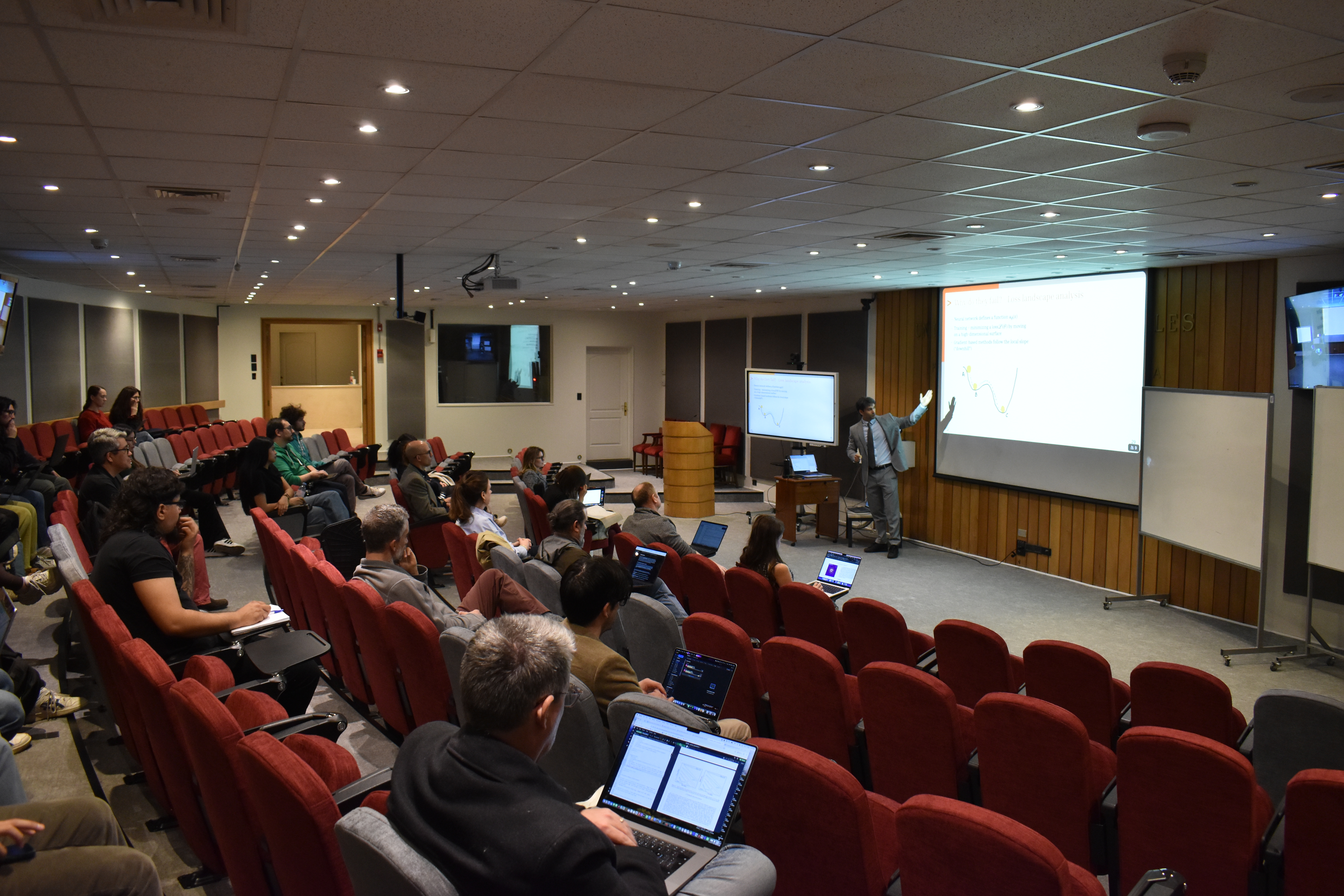
Within this research ecosystem, the project "AI-based Modeling of stellar atmospheres" was born, an initiative that not only represents a technical advancement but also forms the core of the doctoral thesis by Inria Chile–Universidad Diego Portales researcher Theosamuele Signor. Developed under the supervision of researchers Nayat Sánchez-Pi (Inria Chile) and Paula Jofré (Instituto de Estudios Astrofísicos, Universidad Diego Portales). Initiated in March 2022, Theosamuele defended the thesis “Physics-constrained machine learning in stellar spectroscopy” on May 11, 2026, in Santiago, Chile, obtaining the degree of Doctor of Astrophysics.
The research revolves around a central methodological question: How can the physical and chemical information of stars be encoded and inferred from their spectra in an era dominated by large observational catalogs and machine learning models?
Modern stellar spectroscopy faces a paradox: observational catalogs are growing at an accelerated pace—with catalogs producing spectra for millions of stars—while their interpretation still relies on theoretical models of stellar atmospheres limited by computational cost or simplified physical assumptions. Supervised machine learning has established itself as the dominant framework for processing this volume of data, but its predictions remain constrained by the same assumptions of the theoretical models on which it was trained.
The thesis addresses this issue from a methodological perspective, examining how physical structure is encoded within spectroscopic inference frameworks. It does so through three complementary studies that cover the full spectrum of the problem: from the limits of what chemical data can reveal, to new ways of extracting physical meaning without external labels, to the challenges of simulating 3D stellar atmospheres using neural networks.
Verbatim
This strategic collaboration with Universidad Diego Portales reflects our vision of 'AI for Science' as a transformative engine of discovery. Through the co-supervision of this doctoral thesis, we push the boundaries of knowledge in astrophysics, using astronomy as an exceptional laboratory for applying advanced artificial intelligence models. By integrating with the laws of physics, these tools enable us to expand scientific frontiers and enhance the analysis of complex data in one of Chile’s most prominent scientific fields. This fully reflects our commitment to scientific advancement—particularly in our 'AI for Science' line of work—and to talent development, in collaboration with our partners in Chile, such as Universidad Diego Portales.
Director of Inria Chile and of the Franco-Chilean Binational Center on Artificial Intelligence
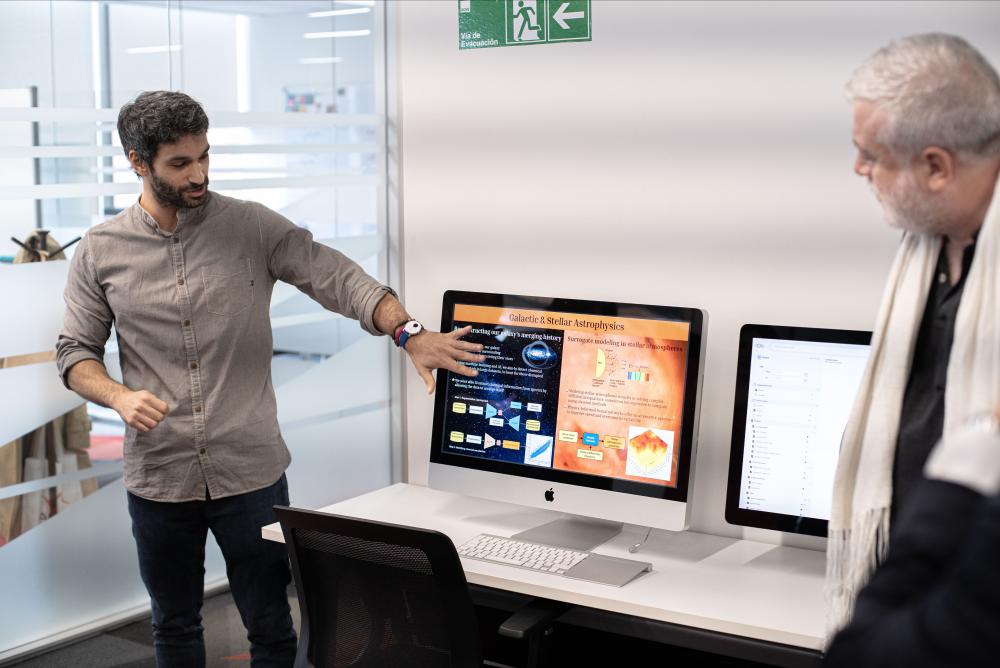
The development of this research is led by Theosamuele Signor, a researcher at Inria Chile and a PhD candidate at UDP. His doctoral thesis has been co-supervised by Dr. Paula Jofré Pfeil, a professor at UDP’s Institute of Astrophysical Studies, and Dr. Nayat Sánchez-Pi, Director of Inria Chile and the Franco-Chilean Binational Center on Artificial Intelligence.
The defense committee, after four years of research, brought together scientists from Chilean and international institutions: in addition to his supervisors, the committee included Dr. James Jenkins (Universidad Diego Portales, Chile), Dr. Szabolcs Mészáros (Gothard Astrophysical Observatory, Hungary), and Dr. Karteek Alahari (Deputy Scientific Director in charge of Artificial Intelligence at Inria, France). This composition reflects the inherently interdisciplinary and international nature of the work, which sits at the intersection of observational astrophysics, machine learning, and numerical simulation.
Verbatim
This work marks an important milestone for UDP’s PhD program in astrophysics, a young program seeking to establish itself globally through cutting-edge astronomy and innovative collaborations. Co-supervising this work with Inria-Chile has been a highly rewarding adventure. I’ve come to know a vast world where science permeates all kinds of environments, and I’m grateful to Inria for opening the doors to that space. Thanks to Theo’s bold work, we’ve been able to explore, as a team, uncharted territories in both AI and astrophysics—which, to me, is one of the most fascinating aspects of science.
Astronomer at the Instituto de Estudios Astrofísicos and director of the Astrophysics doctoral program, Universidad Diego Portales
The thesis articulates three lines of research that, together, provide a structural perspective on the possibilities and limits of using machine learning in stellar spectroscopy.
A central idea in galactic archaeology holds that stars born together share a characteristic chemical signature—analogous to a "stellar DNA"—that could allow the reconstruction of their birth environments a posteriori. The first study assesses the real viability of this strategy, known as strong chemical tagging, using open clusters with known co-natal membership as a controlled testbed.
The result is clear: under current observational uncertainties, the performance of chemical tagging is fundamentally limited by the precision with which abundances are measured, not by the statistical method used to identify clusters. This finding shifts the community’s debate: what is missing is not a better algorithm, but better data.
The second study develops an original self-supervised learning framework with physical constraints, capable of extracting chemically meaningful latent variables directly from stellar spectra, without relying on abundance labels derived from theoretical models. Using an encoder–multidecoder architecture and selective gradient flow control as a physical inductive bias, different latent components specialize in distinct chemical contributions.
The result, demonstrated on synthetic data, is remarkable: the chemical structure emerges from the reconstruction objective itself, without the need to supervise the model with pre-existing abundances. This repositions the role of machine learning in astrophysics: rather than emulating theoretical models, methods can begin to discover physical structure guided by data and carefully designed physical biases.
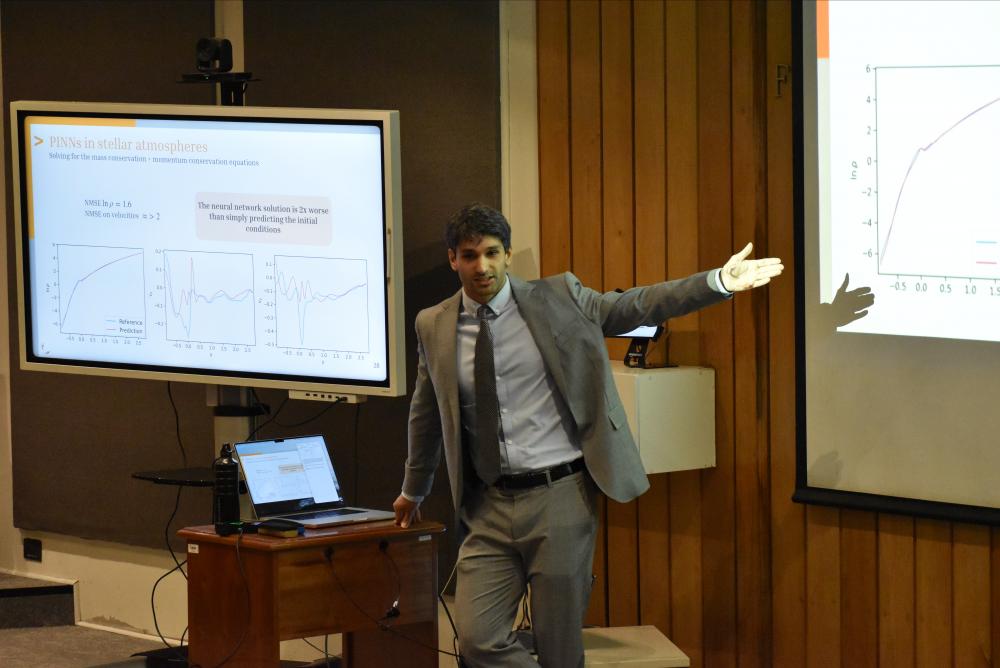
The third axis addresses a question of great practical interest: can physics-informed neural networks (PINNs) replace or accelerate the costly radiation-hydrodynamic simulation codes currently used to model stellar atmospheres in three dimensions? Current 3D simulations require between 10⁴ and 10⁵ CPU-hours per model, making their large-scale application unfeasible.
Through carefully designed numerical experiments, this research identifies fundamental structural limitations in the residual-based formulation of PINNs when applied to the equations governing stellar atmospheres: networks can achieve small residuals while remaining far from the correct solution, and, conversely, physically accurate solutions can produce large residuals. The optimization landscape proves anisotropic and ill-conditioned, derailing training.
Far from being a negative result, this diagnosis represents a first-order methodological contribution: it precisely delineates why PINNs, in their current form, cannot yet replace traditional solvers in this domain and outlines a concrete agenda for developing new formulations of physics-informed learning that account for the stiffness of operators and the numerical conditioning of equations. In other words, it provides an evidence-based roadmap for the next generation of AI-assisted physical models.
Verbatim
There is a lot of enthusiasm surrounding the use of artificial intelligence in physics, but an important part of the scientific work consists of rigorously evaluating which problems these tools can actually solve and which remain beyond their reach. This thesis attempts to contribute precisely to that discussion, combining machine learning, stellar spectroscopy, and numerical analysis from a methodological perspective.
This thesis fully aligns with the programmatic line "AI for Science," which structures the activities of Inria Chile and the Franco-Chilean Binational Center on Artificial Intelligence. Its contributions extend beyond astrophysics: the questions it addresses—how to impose physical constraints in learning systems, how to extract physically meaningful representations without supervision, and how to systematically diagnose the limitations of neural architectures in problems involving stiff differential equations—are directly relevant to many other scientific fields where the integration of physical models and machine learning is being explored.
With the next generation of massive spectroscopic catalogs on the horizon (SDSS-V, 4MOST, WEAVE, MSE, DESI, and Gaia’s fourth data release), the question of how to integrate physical laws, statistical learning, and numerical conditioning into a coherent framework becomes strategic. Signor’s work, co-supervised by Inria Chile and UDP, provides both positive results—such as new ways to learn stellar chemistry without labels—and a precise map of the terrain yet to be conquered.