The AGORA team from Inria presents key advances in the Internet of Things and satellite communications at Inria Chile
Date :

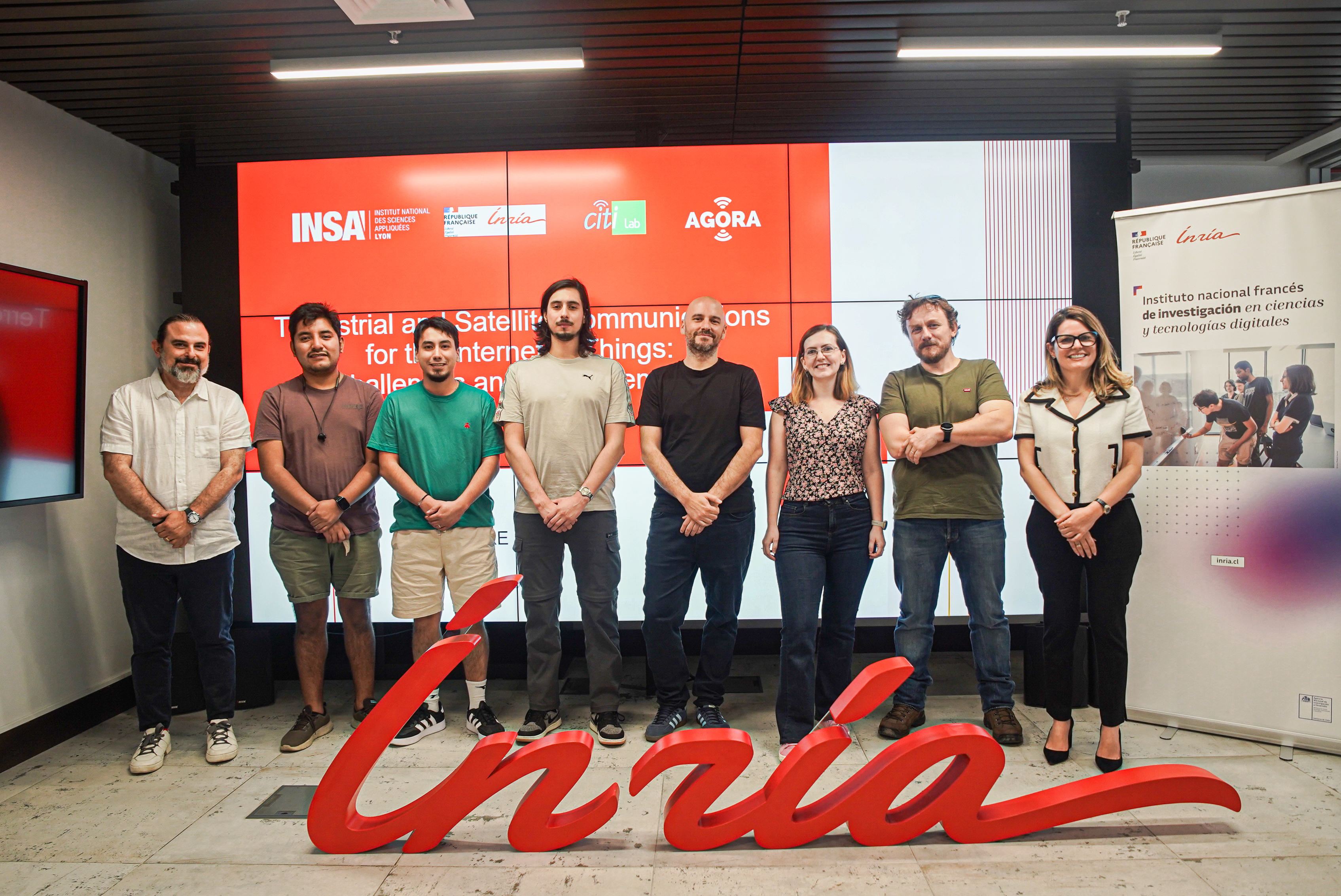
Intending to strengthen scientific collaboration and present the latest innovations in wireless networks, a delegation from the AGORA project-team at the Inria Lyon Centre visited the offices of Inria Chile. The visit was highlighted by the Inria Chile Talk titled "Terrestrial and Satellite Communications for the Internet of Things: Challenges and Advancements" held at Inria Chile’s offices.
The AGORA team specializes in wireless networks for digital cities, covering technologies from Wi-Fi to satellite communications. Hervé Rivano, a professor at INSA Lyon and leader of the AGORA team, explained that the group structures its research around three fundamental axes to address these challenges:
Strategic network deployment for specific applications, optimizing sensor placement for critical tasks such as environmental monitoring of air quality or the use of drones in civil security.
Protocol efficiency and technological convergence, aiming to reduce energy consumption and integrating the "Earth-Air-Space continuum" concept, which combines terrestrial, aerial, and satellite infrastructure to maximize coverage.
Network data analysis, using collected information to adapt technology to urban mobility and social dynamics, thereby strengthening the connection between digital infrastructure and the people who inhabit the territory.
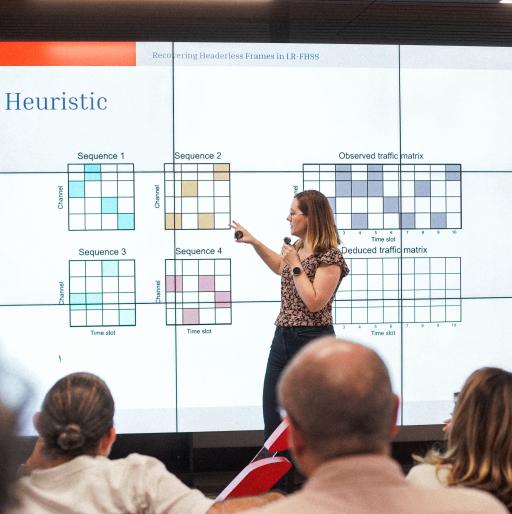
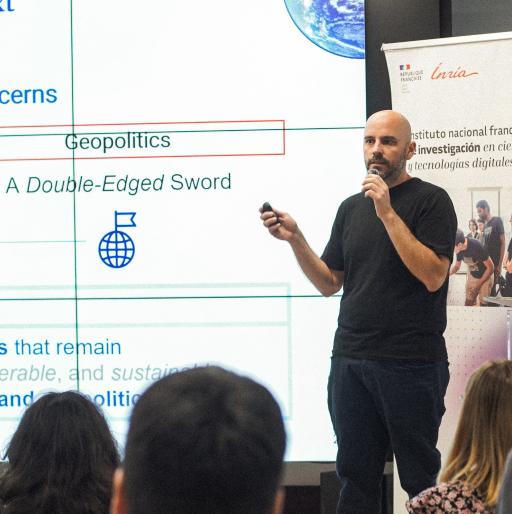
During the Inria Chile Talk, two researchers from the AGORA team, Oana Iova, an associate professor in the Telecommunications Department at INSA Lyon (France) and a researcher at the CITI Laboratory, and Juan Fraire, an Inria researcher and visiting professor at CONICET-UNC (Argentina) and the Universität des Saarlandes (Germany), presented further details about the team’s work. Specifically, they explained how the expansion of the Internet of Things (IoT) poses the critical challenge of ensuring reliable and energy-efficient connectivity for billions of devices. They demonstrated how low-power wide-area network (LPWAN) technologies, such as LoRa and LR-FHSS, have transformed terrestrial IoT deployment and how, thanks to the rise of low Earth orbit (LEO) satellite constellations, these solutions are achieving global coverage.
Oana Iova detailed the team’s work on improving technologies like LR-FHSS (Long Range - Frequency Hopping Spread Spectrum), which is crucial for the robustness of satellite IoT: “I presented ways to enhance an existing technology, LR-FHSS, which is widely used today for satellite IoT communication, and how to address the losses that typically occur in the channel while still being able to recover the information.”
For his part, Juan Fraire delved into the scope of the team’s research, which extends beyond Earth’s orbit: “I came to present our research lines in satellite and space communication networks, focusing on three main areas: broadband communications like Starlink to provide global internet access, IoT communications to connect very small, low-power devices directly to satellite networks, and deep-space communications in lunar and Martian environments.”
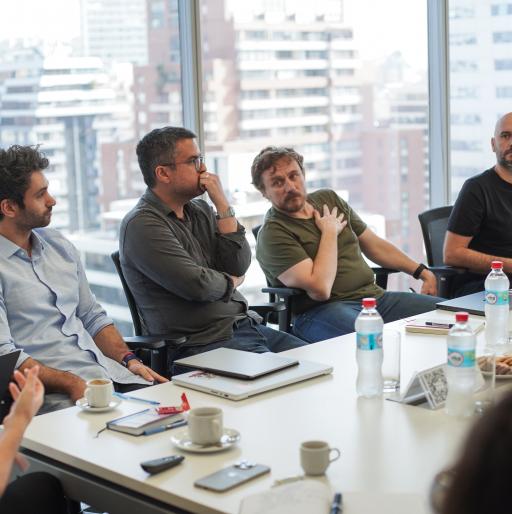

In addition to the Inria Chile Talk, the agenda included activities designed to deepen mutual understanding between the teams. During their visit to Inria Chile, the AGORA researchers toured the offices and held meetings with the local team. These interactions provided an in-depth look at the various research projects and initiatives currently being developed by the center in Chile, helping to identify points of convergence and new opportunities for collaboration.
The visit reinforces a long history of cooperation between the AGORA team and the Chilean scientific ecosystem. Nayat Sánchez-Pi, Director of Inria Chile and the Franco-Chilean Binational Center on Artificial Intelligence, highlighted the significance of the visit, stating: “AGORA is a success story of a team that not only collaborates with Chile but, through Inria Chile, expands that collaboration. Their work in the Internet of Things and satellite communication is fundamental; it connects deeply not only with computer science from its mathematical foundations but also with artificial intelligence in the field of optimization.”
Franco-Chilean and Franco-South American Scientific Community in IoT and Satellites Strengthened by Inria ChileThe AGORA team, based at the Inria Lyon Centre, has a long history of collaboration with Chile and Latin America. In 2021, the team secured its first AmSud funding with the STARS project (SaTellite networks Architectures pRotocols and informaticS), partnering with researchers from LAAS-CNRS, the Universidad de Chile, and the Universidad Nacional de Córdoba. Through Inria Chile’s Mobility Program, the team has hosted three Chilean university students for three-month research internships since 2022. Two of them, Diego Maldonado, a former student at the Universidad de Chile, and Carlos Fernández, from the Universidad Técnica Federico Santa María, are now pursuing their PhD studies within AGORA. Collaborations continue to grow with two new projects in 2025: DORSAL-IOT, supported by Inria’s Associate Teams program and the STIC AmSud program. The Franco-Chilean project DORSAL-IOT: Downlink Optimization for Robust Direct-to-Satellite Communication in the Internet of Things is led by Oana Iova (AGORA) and César Azurdia (Universidad de Chile). It brings together eight researchers and students from Inria, including the two aforementioned PhD candidates, and a dozen researchers from the Universidad de Chile and the Pontificia Universidad Católica de Chile. Among them is PhD student Cristóbal Huidobro, who also completed an internship at Inria through the Mobility Program. The STIC AmSud project unites scientists from France, Chile, and Brazil, with researchers from the Universidade Federal de Santa Catarina, led by Richard Demo Souza. In France, the project is coordinated by Oana Iova, while in Chile, coordination is shared by César Azurdia from Universidad de Chile, Diego Dujovne from Universidad Diego Portales, and Samuel Montejo from Universidad Tecnológica Metropolitana. This IoT and satellite-focused ecosystem convened at Inria Chile during the AGORA research team’s visit to participate in the Inria Chile Talk, explore Inria Chile’s key initiatives, and identify potential new avenues for collaboration. |
This international cooperation also aligns with one of the core objectives of the AGORA team: to connect research with the real needs of communities. Hervé Rivano, a professor at INSA Lyon and leader of the AGORA team, explained that within his team, “we are strengthening our relationship with South America, particularly Chile, through the associate teams program and projects like STIC-AmSud. All these initiatives revolve around IoT and satellites, aiming to connect devices in remote areas and integrate space technology with drones. It’s a long-standing collaboration we seek to enhance, especially as Chile’s space community grows and its IoT expertise remains strong.” Guided by this vision of technology that serves people and connects with their environment, the team actively engages with Latin American talent. In this context, Juan Fraire emphasized the strategic importance of this partnership for developing cutting-edge projects, noting that “a significant part of the AGORA team, including PhD and postdoctoral students, are Chilean.”